
a flood of both contextualised and uncontextualised thoughts on the oversaturated modern web.
by writer, editor, and artist apoorva sripathi. I used to write a newsletter called shelf offering.


chi, cha
tamil, nouns
disgust, disbelief, shame, refusal…
How you express disgust says a lot about you. Most people scrunch up their face into a crinkle, some avert their eyes; my partner goes 'uehhh' or fakes gagging with his mouth formed into a perfect circle. I will only utter a loud cheee or a cha (not to be confused with the hot beverage, chai) with a straight look at whatever repulses me. I think a lot of Tamils do it too. But if you ask me (or us) what it means, I will freeze and pull my face into an incomprehensible expression, just like what the word represents. There is simply no word to describe these noises except as an interjection. Actually, chee (or a short, curt 'chi') can mean many things –– shame, disgust, loving refusal, surprise, a polite refusal of things as they are if repeated back to back ('chi chi') –– and so can 'cha', from disbelief and disappointment to a longing for something that cannot be brought back from time. Can two words contain entire cosmologies of the vocabulary of disdain? Perhaps.
The closest word I can compare these to in English is 'fuck'. Fuck yes, is a resounding agreement, while fuck no is emphatic disagreement. There are many ways to swear and express anger, displeasure, doubt, repugnance, and generally other unpleasant emotions, but so far none have achieved the magnitude that fuck can represent. Fuck, along with play and set, is a polysemous word, maybe not in the truest sense but in the way that you say it. Fuck is also etymologically difficult to trace, which not only makes it pliable as a word but also pleasurable. I find such elasticity and pleasure with using chi and cha, both of which are polysemous words, i.e. words that have many meanings, in a galaxy of other such words in Tamil.
The first time I used chi in front of my English-speaking partner, it was snappy and unceremonious. My partner, delighted that I was speaking in Tamil, tried to imitate the word in a similar tone and voice. It made us both laugh. I said 'cha' out loud – I was missing my sister, my comrade in such activities. We grew up liberally using chi, cheeee, and cha in various cadences for things that so much as mildly annoyed us – we used it for almost everything. But here I was, three decades later, unable to coherently explain the concept of such words to my partner, who assumed it to be a swear word. It wasn't fuck, but the way you say chi matters.
Tamil swear words are more vulgar than ones in English because Tamil is as much a bodily language as it is guttural and retroflexive i.e. sounds are crucial for distinguishing words. On this journey of explaining Tamil to my partner, I was telling him the difference between ennai (me) and eNNai (oil) which is also the basis of a popular joke from a Tamil movie, bear with me here. A man who arrives at the big city, and is asked to mind his brother-in-law's corner shop for a few hours, decides to have fun with one of his customers using Tamil. In turn, the customer decides to play with him via Tamil as well. The shopkeeper asks 'what do you want' and the customer replies 'I want oil' which gets translated to both 'what the hell do you want' and 'oil'. This exchange goes on for a while till the shopkeeper is left harried by this conversation. When he finally realises he's being played and understands what the customer actually wants, he brings him groundnut oil on request. When he's about to pour the oil into a glass bottle, the customer baits the shopkeeper again with 'is this good oil'. You'd be forgiven for thinking that this was a normal question but the words for good oil in Tamil can also interchangeably mean sesame oil. And so it turns out that the customer was merely asking if the oil was of a decent quality while also pulling the shopkeeper's leg. There is more to this joke which ends with the shopkeeper running back to his village but I couldn't accurately translate it entirely to my partner. And even if I did, I found that there were gaps in comprehension and ultimately, a loss.
Translation brings forth a third language, a liminality between where you have been and where you want to go, a frankenmonster between Tamil and English, which volunteers an ambiguity. How this ambiguity can give way to clear meaning is through intonation, context, and purpose with little oddities sprinkled throughout. As an Italian phrase goes, translators are traitors; you can either sell yourself out and produce a flawed meaning or you stay true to the language and fumble through words, concepts, and significance. I think either way, the translation is knotted, confusing, and inherently ruined. In such cases, you simply have to say chi or cha and walk away.
i
My mother and I recently emptied out our "loft", which is just a fancy term for unwieldy cupboards that were built high up by some nameless architect, some above a bed and some right below a fan that makes retrieving objects an ominous chore. To make matters worse, I ALWAYS think the fan will lop my head right off even though I have grown up with them and cannot live without their pleasant white noise, especially at night. You know those white noise machines or ones that make whale sounds/jungle sounds that western TV shows seem to be touting? I just prefer ceiling fans, both economical and practical.
However, our loft isn't merely contained to cupboards above, it is hidden in plain sight. That is, if you know where to look. Our narrow balcony functions as one, where my grandfather’s golden pothos (or money plant as they call it here) rests atop the family ammikkal1. After numerous injuries to our big toes, four of us took turns to move it to the terrace where it plays host to pigeons, squirrels, and the occasional cat that finds the stone cool enough to nap on.
I last remember my mother using the ammikkal when I was 6, crushing vethalai (betel leaf) and poondu (garlic) in a forward-backward motion, adding rock salt to break down the ingredients into a paste. This she mixed with rice, black pepper and ghee, and tempered mustard and curry leaves. I'd eat this every time I fell sick – which was often – and the ammikkal would be brought out. Slowly, we phased out the ammikkal, switching instead to the iconic red and white Sumeet mixie. It saved precious time, especially for my mother, who was able to transfer those minutes to the office. (It also outlived my grandfather.) For my grandmother, it meant that she had to start standing up to cook, chop, and grind because she could no longer squat or sit to use the ammikkal and the aruvaamanai.
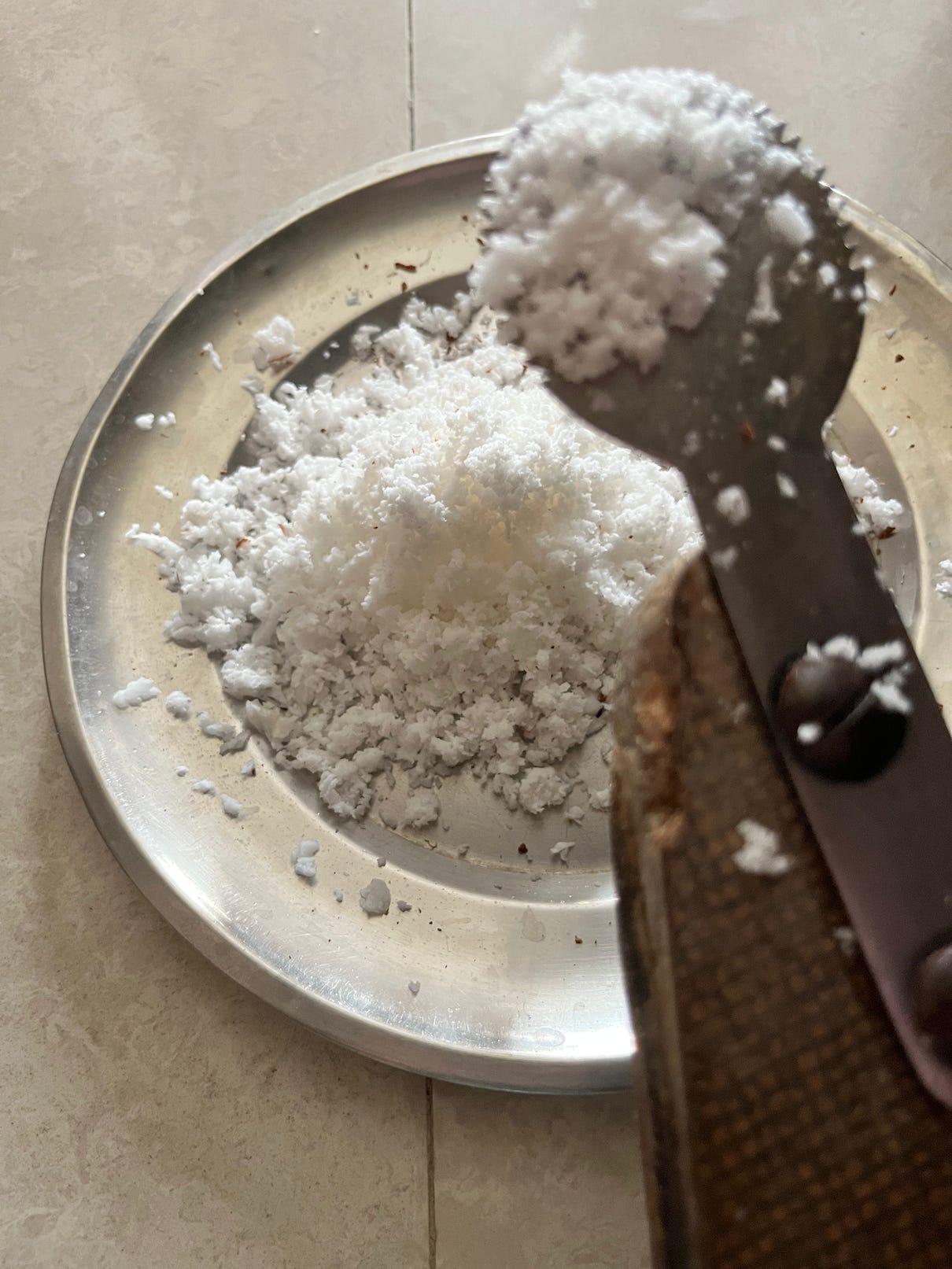
The aruvaamanai, or the bonti as it's known in Bengali, has a chapter dedicated to it in Chitrita Banerji's brilliant book, The Hour of the Goddess. In it, Banerji writes that the bonti is "a protean cutting instrument on which generations of Bengali women have learned to peel, chop, dice, and shred". This is true of most Indian women belonging to generations before me, sitting cross legged with one leg on the manai/bonti, and the other folded beside it or behind the back; or a knee raised in front. The first time always seems convoluted, as I found out when I tried shredding coconut on its serrated head one afternoon. I haven't used it since – somehow standing seems more straightforward, more simple to me. I can move around (my cooking is as chaotic as my thought process) and clean things on the go. Plus, I find it easier to have everything near me when I cook, since the set up is standing.
But I can’t deny that there’s an elegance to using the aruvaamanai. My mother is more comfortable with it, still cutting and peeling vegetables and shredding coconuts – the shavings falling like white snow – her head bowed down when she's working, silently also sampling the gratings (and offering us some). There's also the curve of my mother's back to the left, while she leans on her right knee with her right elbow to secure the coconut with her right hand, using both hands to gently turn it back and forth against the blade to shower down lush coconut. Banerji succeeds in poetically describing what I set out to express: "Holding the vegetable or fish or meat in both hands and running it into the blade makes the act of cutting a relatively softer, gentler motion than the more masculine gesture of bringing a knife down with force on a hard surface: the food is embraced even as it is dismembered."
Taking its roots from அரி (pronounced: aruh) or அரிவாள் (pronounced: arivaaL; the bill-hook), and மணை (pronounced: maNai), the aruvaamanai is obvious in its design. Aruh is to slice/cut and maNai is a seat or a low stool. Its use stretches beyond the kitchen. Banerji also notes this in her book, that women use it to defend themselves; after all it is a bill hook attached to a seat.
My most enduring memory of this is watching the popular Tamil soap Thirumathi Selvam as a teenager with the family, and seeing the title character pick up the instrument lying in the background to defend her husband. The message was more than "look how brave Archana is!" – it was also about how Archana, a simple housewife, saw the aruvaamanai as more than just a kitchen tool. Its efficiency extended to defending herself (and her husband) with it, if necessary. Did the aruvaamanai make Archana see things in a different light? Maybe I’m reading too much into a soap, but it proved that Archana was adept at the aruvaamanai, whether cutting vegetables or daring to cut her brother-in-law's throat2.
Aruvaamanais are regular fixtures at our local vegetable and fish markets – I remember our regular vendor slicing a cabbage in one straightforward motion, an act that was as exciting to watch as it was, I'm sure, to actually perform it, in one lithe motion. It is – to someone who doesn't know how to work it – like an amazing illusion, an impossible feat! To the illusionist, it is mere sleight of hand.
The term bonti, Banerji writes in her book, has been present in Bengali for many years, deriving from “the language of the ancient tribal inhabitants of the eastern regions of the subcontinent.” She also cites historian Nihar Ranjan Roy’s evidence (in his book Bangalir Itihas) of indigenous people who settled in Bengal much before the advent of the Aryans in India, “and whose language, customs, and ritualistic beliefs still permeate the cultural life of Bengal”. Banerji, like me, is of the opinion that the bonti (in my case, the aruvaamanai) is inextricably associated with (Bengali) women, and the “image of a woman seated at her bonti, surrounded by baskets of vegetables, is a cultural icon.”
Writing for the Museum of Material Memory, Kasturi Mukherjee recalls that the bonti has been a “matrilineal heirloom in the family existing through four generations now”. More interesting are its associations with sexuality and identity that the author draws upon, writing that the knife reflects a masculine identity, and affirming the above thoughts that the bonti is erotic and feminine.
The bonti however challenges this masculine notion. You will only rarely notice a man at a bonti, except for perhaps at Bengali fish markets for commercial purposes and even then the cleaver is more popular. Bonti reflects the feminine. The bonti is basically a curved blade rising out of a narrow, flat base. The curves of the bonti become synonymous with the soft curves of the female. Smooth and flowy, it is opposed to the linear, unswerving, hard structure of the knife.
Are all knives created the same?
The mezzaluna, a metallic crescent moon graceful in its design, belies its appearance – I remember watching Nigella Lawson going to town on a handful of parsley with it, attacking the leaves and stems. On the other side of the television, I was wincing; for I didn’t want my fav to cut herself by mistake! Over an Instagram conversation, I asked food writer Rachel Roddy3 on her thoughts about the instrument. She told me about a small one that she employs mainly to chop parsley. “[It's] v common in Italian [kitchens]. My very general reading suggests they date back to the renaissance kitchens, but I bet they predate that... Maybe arriving with the Arabs in Sicily.”
I cannot find an established timeline for when the mezzaluna was invented, neither can I help wonder if its half-moon shape is a nod to one of the most important symbols in Islam. Roddy also mentioned that it wasn't an instrument that is passed down in Italy, and that her “Sicilian mother-in-law has never used one.” Scott Weiner (in this piece for Serious Eats) attributes the invention of the mezzaluna to one Silvio Pacitti in 1708, calling it a precursor to the pizza slicer. I don't know which timeline is right, but I agree with Weiner on the “elegance of a curved blade4” – whether the aruvaamanai, mezzaluna, or the Inuit knife, ulu.
Part ii will be published the week after next.
1. A stone crusher: on a heavy flat slab are placed the ingredients to be ground with the help of a cylindrical stone that was rocked on top with a to and fro motion. In Comentarios Reales de los Incas (The Royal Commentaries of the Incas and General History of Peru - an edition printed in the United States), Inca Garcilaso de la Vega writes of a similar implement that the Indian (South American Indians) women used to ground maize into flour, “which we might reasonably describe as a batán.” It has been used in South America since before the arrival of the Spaniards. It’s known by many names in many regions of India.
2. While researching for this piece, I also came across many articles where the aruvaamanai was used in petty fights.
3. This happened in early 2022. I know I know, I have been labouring over this for a long time.
4. Curved blades are found throughout history and in various cultures around the world, including Khanjar, Jambiya, sickles in the Neolithic Era, in the Bronze Age, and since then.